St. Johnsbury Band

Our History
The St. Johnsbury Band celebrated its 175th anniversary in 2005. Founded in 1830, the St. Johnsbury Band is the nation's third oldest, continuously-operating community band. Only the West Point Military Band (1827) and the Allentown, PA Band (1829) are older, with Allentown being the other community band in this historic trio.
The St. Johnsbury Band has been known by several names throughout its history. It was originally known as "The Brass Band" and played under that name until 1859 when it became "The Cornet Band". The Band continued to be known as "The Cornet Band" until 1885, when another name change labeled the Band as "The Serenade Band". In 1912, a competing band in the town merged with "The Serenade Band" and the combined group became known as the "St. Johnsbury Consolidated Band". That name was later shortened to the current "St. Johnsbury Band".
Through the years, the St. Johnsbury Band has played in many places. In the early years, the main site for concerts was in a bandstand in Arnold Park at the north end of Main Street. The Band often played at rallies in Monument Square next to the courthouse during the Civil War. Those performances were held to enlist men in the Union Army.
Benjamin Harrison was the first President the Band had the honor of playing for. He was escorted in a parade to the Colonel Fairbanks mansion on Underclyffe Street. The St. Louis Exposition in 1893 was the site for another Band performance. The "St. J March" was written around the turn of the century when the Band had 25 members. In 1912, Theodore Roosevelt was in the audience for a Band concert at the courthouse. That same year, voters in St. Johnsbury started an annual allocation of $1000 to the Band to help cover their expenses. The string of funding was broken in 1979 but was restored in 1980. This annual funding has continued but has been decreased to its current level of $770.
The 1920's and 1930's were good years for the Band - it organized an international band association and sponsored band festivals. These festivals included groups from Vermont, New Hampshire, and Canada. The crowds attending these concerts often numbered in the thousands. The World War II years saw

Do you know this Band member?
23 members of the Band serve in active duty in the armed forces. All 23 of these members survived the war with many earning decorations for meritorious service. While so many men were serving the war effort, women were allowed to join the Band for the first time. Their contribution was significant and continues so to this day.

St. Johnsbury Band performing in the bandstand in Courthouse Park
Since the 1950's, the St. Johnsbury Band has continued to play and delight the communities in St. Johnsbury and in surrounding states. The Band's Monday night outdoor concerts during the summer in the bandstand in Courthouse Park have been a longstanding tradition enjoyed by all ages. Memorial Day and Veterans Day parades also see the Band participating. Arthur Fiedler of the Boston Pops became an honorary conductor in 1978. The Band frequently plays at fall foliage celebrations and joins the St. Johnsbury School and St. Johnsbury Academy bands for an annual spring Festival of Bands performance. The Band also has a longstanding tradition of performing in the Woodsville-Wells River 4th of July Parade and presenting a 4th of July evening concert in North Woodstock, NH.
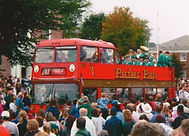
Peter Pan bus at the Big 'E'
The St. Johnsbury Band represented the State of Vermont on Vermont Day at the Eastern States Exposition (the Big "E") in 2002 and 2003. The Band played a midday concert and then performed later in the day at the big parade through the Big "E" fairgrounds. One year was highlighted by riding on the top deck of a red Peter Pan bus with Captain Hook and Peter Pan while the other year was marked for performing in the parade before a record crowd of over 154,000 guests!

St. Johnsbury Band at the Big 'E'
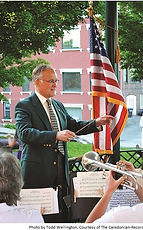
Governor Jim Douglas conducting the Band
Challenges are not new to the St. Johnsbury Band either. In 1999, the Band combined forces with a unit of the Vermont National Guard and performed a full version of the 1812 Overture, complete with cannon, for the 4th of July. The Band performed in the 1st Annual Lake George Band festival in Lake George, NY as part of its 175th anniversary in 2005. Yet another highlight in Band history was a Farmer's Night concert in the rotunda of the Statehouse in Montpelier, Vermont.
Former Governor Jim Douglas was the guest conductor to open the Band's summer 2012 season. Governor Douglas is a musician and has performed with other groups in Vermont. He was a very able conductor.
Peggy Pearl, the director of the St. Johnsbury History & Heritage Center wrote this brief history of the Band. It appeared in The Caledonian-Record (6/27/2012). Click here to read the article. The History & Heritage Center opened a permanent exhibit of Band memorabilia on July 1, 2019. The Band performed a concert on the grounds of the center to mark the exhibit opening.
The Band enjoys serving the community of St. Johnsbury with its opening summer concert at the St. Johnsbury Health and Rehabilitation Center and closing each season with its annual Christmas concert which includes a visit from Santa himself!
Bandstand History
The Band currently performs its summer concerts in the bandstand in Courthouse Park. However, this is not the original bandstand for the Band. In the early 1900's, the Band performed in a bandstand located at the corner of Railroad Street and Eastern Avenue. These images from a 1906 postcard show the snow-covered bandstand when it was located in this downtown location.
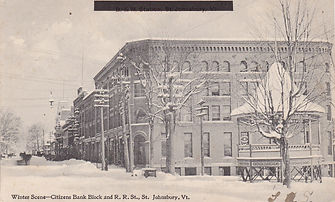
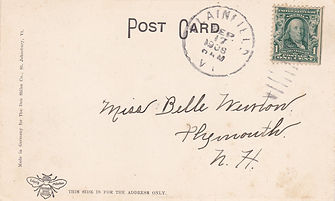
Here is a brief history of the current bandstand, courtesy of John Gebbie (owner of St. Jay Hardware) and Archie Prevost (St. Johnsbury Rotary).

In 1983, the St. Johnsbury Rotary Club decided to do a community club project for the St. Johnsbury Band, the 3rd oldest town band in the country. The community decided two bandstands weren't needed. The old bandstand in the park by the railroad station on Railroad Street was torn down. The bandstand at the courthouse was old and a new one was to be built in its place. On June 6, 1984, new design drafts were drawn up.
Bandstand Christmas 2015
Ground breaking was planned for May 1, 1985. Jim Dewitt was president for
three months in 1985. Archie Prevost was president for twenty-one months ending in 1986. Sean Duffy from Fairbanks Scales had all the steel and welding work done. He would also oversee the project. Archie wire brushed and painted the steel for several nights. John Gebbie, assistant to the project, tore down the old bandstand with the help of Don Bostic's son, Glenn. He used the old materials at a camp on Joe's Pond. Durward Ellis donated the Kyanize paint. Karl Armstrong Masonry did the brick work.
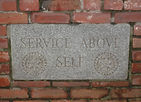
Bandstand Rotary Stone
Anair Memorials donated the granite for the Rotary emblem, which can be seen on the north side of the bandstand. Dale Wells handled the building construction. Armando Young installed the pad (floor). William Rodd of Rodd Roofing put on the roof.

St. Johnsbury Band performing in the bandstand Summer 2016
The location of the bandstand was picked knowing the addition to the courthouse was coming. Murphy Electric wired the bandstand. Landscaping was done by Dave Clark, the St. Johnsbury town manager, and was overseen by Linda Garey of the Beautification Committee. Jim McGregor assisted in the design of the interior roof to achieve the best acoustics.
Construction was completed in the spring of 1986 and the Rotary Club turned it over to the town. Dedication of the bandstand was done by Archie Prevost and Sean Duffy at the first Monday concert in June 1986.
What's Up with the Red Socks?
Anyone who has attended a St. Johnsbury Band concert may have noticed that many band members are wearing red socks as part of the uniform. After John Mead, the Band's excellent trombone player, passed in 2014, the Band decided to honor him by wearing red socks as part of our uniform.
Why red socks? Here is the story behind John and red socks.

St. Johnsbury Band members and their red socks
John Mead, Professor of Music at Marshall University, believed that wearing red socks for a performance brought good luck. He wore them for his solo faculty recitals, ensemble concerts with the WV Brass Quintet, the Huntington Symphony, university events, and all kinds of shows featuring visiting artists. The only time he did not wear them was for performances of the WV Symphony (and occasionally he may have, even there). His studio students wore them for their own performances; his university trombone ensemble, The Golden Slippers, made a point of displaying them casually at performances. After their graduations, his students continued to wear red socks whenever they played.
Back in John's undergraduate years at Ithaca College, the Ithaca Band was considered one of the best concert bands in the country. This was a fine, serious ensemble, and men in the Ithaca Band wore tuxedos. At one concert, a good friend of John's forgot to change his socks and played the entire concert wearing bright red ones — unfortunately the friend was the concertmaster, so his feet were especially visible. The story is that the Dean of the Music School happened to attend that concert and was so exasperated by those flashes of color that he ordered the concertmaster out of the band for a month.
John was highly amused by this incident. He began to wear red socks for his own performances, when he could. Eventually, it became a habit, a good luck charm to ensure a fine performance.
The St. Johnsbury Band wears red socks for its performances to honor John and carry on this tradition.
Historical Photos

This is a photo of several Band members from the 1870's. The man in the impressive looking uniform in front was the Regimental band leader. Several Band members are behind him. The braid on the sleeves of his uniform was gold and was known as "chicken guts" during the Civil War. It was very popular on dress uniforms, especially in the South. He has on a bear skin cap which was also worn during dress parades. His uniform is far more ornate than those of the regular Band members. Note the impressive mustaches on several of the men.
This photo is of the St. Johnsbury Band at the Caledonia County Fair on September 21, 1899. The photographer, C. H. Clark, wrote in the names of many of the Band members. It is the oldest photograph we are aware of with member names.

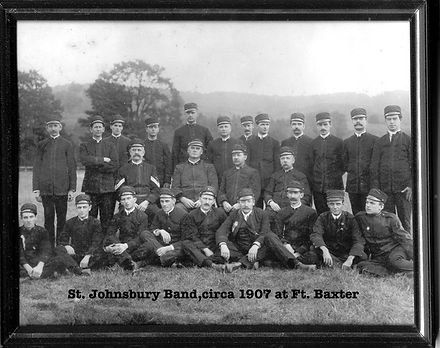
This is the St. Johnsbury Band at Ft. Baxter, just south of downtown St. Johnsbury, in 1907. This was the campsite for the Third Regiment located on the site of the old fairgrounds. From A Brief History of St. Johnsbury by Peggy Pearl (pp 123-128).
These photos are from Clare Dunne's Pictoral History of St. Johnsbury.

St. Johnsbury Center Bandstand (1930)

St. Johnsbury Band in front of St. Johnsbury Center Bandstand (1930's)

Railroad Street Bandstand in St. Johnsbury (1949). This bandstand was torn down in 1983 when the current bandstand in Courthouse Park was built.
St. Johnsbury Center Bandstand (1930)
Great White Fleet
The Great White Fleet? Wasn't that a fleet in the United States Navy after the Civil War? The hulls of the ships were painted white since the nation was at peace. What does this fleet have to do with the St. Johnsbury Band?
As you might guess, the connection is through music in the Band's library. While going through the library, we came across this old overture called "The Enchantress". It had the stamp "USS Vermont" on it. This led to some research about the Great White Fleet and this overture, which you can read here. Click on the images to see the solo cornet part with the USS Vermont stamp and the USS Vermont itself.

USS Vermont

USS Minneapolis
Our search through the Band library found more pieces that were on ships of the Great White Fleet. Another piece was "The Bridal Overture" that was on the USS Minneapolis. Read about this overture here.
Band Trivia
Over the years, items regarding the St. Johnsbury Band have appeared in the Caledonian Record.
This bit of trivia appeared in the on January 9, 1874:
New Year's Eve celebrations in the area included an open house at the St. Johnsbury Athenaeum which featured the lighting of the art gallery by gas for the first time. The St. Johnsbury Band provided musical entertainment for the gathering. The art gallery had been added to the Athenaeum earlier in 1873.
This item was in the paper on August 14, 1874:
Friends of Mr. and Mrs. Horace Fairbanks showed up unannounced to celebrate the Fairbanks' 25th wedding anniversary. Fairbanks built and donated the Athenaeum to the town. Mr. and Mrs. Fairbanks accepted the guests and it became a party. Later in the evening, the St. Johnsbury Band showed up to play on the front lawn.